
Ukraine:
Google BatchGeo map of locations in Ukraine that have Koberstien records
| Christian Koberstein (FamilySearch decendancy view) was born about 1866 in Sudelko, Ukraine. Rudolof his son is listed on the Ellis Island database. Rudolf's ethnicity was Ukraine German and residence was Koyszullen, Germany and arrived in the U.S. on 22 Jul 1922 and he was 19 years old (calculated birth year is 1903 which is in agreement with the Social Security Death Index). He was a single male and departed from the port of Bremen, Germany. He is listed with the married individuals Christian (calculated birth year of 1866) and Anna (calculated birth year 1860). This is very probably the parents of Rudolf. Christian Death Certificate in Ohio gives father as Martin Koberstein and mother as Anna Maria Fitz. | |
| Julius Koberstein was 48 years old at this immigration to the U.S. and was a married male at the time. He was from Russia and of the German race. The name of the city he is from is written but hard to read, it looks like 'Vodays'. His nearest relative in the country whence he came was his wife Matilda Koberstein whose address is also give as the city poorly transcribed as 'Vodays'. The final destination is indicated as Gillet, Wisc. Julis had been in the US before from the period 1909 to 1912 in Leona which appears to be a city in Wisconsin as it is mentioned as such in Matilda's ship manifest information. He was indicated as going to stay with an Uncle Ludwig Freitag in Gillet (also Wis. as per other information). | |
| Bernhard (passenger list mage) immigrated to the U.S. and arrived at Ellis Island on 25 Jun 1905 joining brother Gabriel Koberstein. Bernhard was Hebrew. | |
| Joseph (1895->1920) brother in law of Lina Magdoff nee Roberstein (1890->1920) found in the 1920 census immigrating to the U.S. in 1913. | |
| http://pixel.cs.vt.edu/library/ssrch.html |
Search of St. Petersburg Archive Extractions. For the query, Koberstein, of category St. Petersburg
| Last, First Name | D/M Year | Place | Father | Mother | Film/Item | Pge | Reg | Remarks |
| Koberstein, Emilie | 4 Oct 1869 | Marzelindorf | Christian | Ortel, Dorothea | 1884113/1 | 222 | 606 | |
| Koberstein, Johann | 1 Jan 1869 | Gluecksthal | Johann | Golder, Dorothea | 1884128/1 | 555 | 248 | |
| Koberstein, Johann | 10 Sep 1871 | Gluecksthal | Johann | Golder, Dorothea | 1884114/1 | 519 | 290 | |
| Speier, Helena | 8 Mar 1873 | Ferdinand | Koberstein, Justine | 1895621/1 | 334 | 544 | ||
| Speier, Karl | 11 Feb 1871 | Bereslowicz | Ferdinand | Koberstein, Justine | 1884128/1 | 588 | 546 |
| Last, First Name | D/M Year | Place | Father | Mother | Film/Item | Pge | Reg | Remarks |
| Baar, Otto Albert | 8 Jul 1879 | Heimthal | Kristian | Koberstein, Wilhelmine | 1895627/2 | 777 | 101 | godparents: Kalis,
Erdmann and Maron, Mathilde |
| Jans, Alwine Emilie | 30 Dec 1878 | Heimthal | Michael | Schlag, Emilie | 1895627/2 | 768 | 2 | godparents:
Koberstein, Ludwig and Koberstein, Louise |
| Kienitz, Johann | 25 Apr 1876 | Beresdaars? | Gottlieb | Koberstein, Christine | 1884069-2 | 537 | 1100 | |
| Robersten (?), Pauline | 10 Dec 1878 | Glucksthal | Johann | Golder, Dorothea | 1895627/2 | 539 | 462 | maybe Koberstein |
| Zahn, Augustine | 6 Sep 1876 | Pulin Hutte | Gottlieb | Koberstein, Rosina | 1884071/1 | 598 | 20 | |
| Zahn, Emilie | 2 Aug 1879 | Heimthal | Gottlieb | Koberstein, Rosalie | 1895627/2 | 795 | 310 | godparents: Wiesendorf, Ferdinand
and Riemer, Rosina |
| Last, First Name | D/M Year | Father | Mother | Film/Item | Pg R | Nr | Place |
| Brandt, Wilhelm (4) | 29 Jan 1885 | August | Koberstein, Wilhelmine | 1897692/1 | 233 | 335 | |
| Duesterhoeft, Emil (3) | 18 Dec 1885 | Friedrich | Koberstein, Justine | 1897692/1 | 431 | 2141 | Wodschin |
| Fenner, Gustav | 7 Mar 1880 | Christoph | Koberstein, Christine | 1897594/1 | 525 | 576 | Feodorowka |
| Illegible, Wilhelm | 26 Feb 1882 | Friedrich | Koberstein, Christine | 1895614/3 | 418 | 220 | Sergejewka |
| Kienitz, Karoline (1) | 1 Mar 1885 | Gottlieb | Koberstein, Christine | 1897691/6 | 48 | 521 | Radischtsch (Raditsch ?) |
| Koberstein, Emil | 27 Dec 1879 | Michael | Steckmann, Luise | 1897596/1 | 939 | 81 | Pulin Huta |
| Koberstein, Emilie | 24 Dec 1882 | Michael | Stockmann, Louise | 1895615/1 | 833 | 572 | Heimthal |
| Koberstein, Ernestine | 3 Jan 1882 | Michael | Illegible, Emilie | 1897596/1 | 625 | 1223 | Friedrichsdorf aka Solomka |
| Koberstein, Friedrich | 18 Oct 1882 | Gottlieb | Kuehn, Wilhelmine | 1895615/1 | 833 | 571 | Heimthal |
| Mittelstaedt, Ferdinand | 16 Feb 1881 | Gottlieb | Koberstein, Juliana | 1897594/1 | 404 | 567 | Raditsch |
| Mittelstaedt, Hulda | 18 May 1876 | Gottlieb | Koberstein, Juliana | 1897594/1 | 405 | 567 | Raditsch |
| Petrick, Helene (2) | 22 Jan 1885 | August | Koberstein, Rosine | 1897692/1 | 117 | 1374 | Selaznitza ? (Zeleznica) |
| Zahn, Friedrich | 3 Apr 1882 | Gottlieb | Koberstein, Rosalie | 1897596/1 | 940 | 91 | Pulin Huta |
Last, First Name |
Baptism/ ChristeningDate |
Father |
Mother |
Place |
indexing project (batch) number: |
source film number: |
Kienitz, Karoline (1) |
2 Mar 1885 |
Gottlieb |
Koberstein, Christine |
Shitomir, Russia |
I05002-6 |
1897691 |
Wenzlaw, Gottlieb |
24 May 1885 |
Samuel |
Koberstein, Justine |
Kiev, Kiev, Kiev, Russia |
I05002-6 |
1897691 |
Koberstein, Emil |
9 Jan 1884 |
Andreas |
Taube, Susanne |
Kiev, Kiev, Kiev, Russia |
I05002-6 |
1897691 |
| Petrich, Helene (2) | 25 Jan 1885 | August | Koberstein, Rosine | Shitomir, Russia | I06552-5 |
1897692 |
| Düsterhöft, Emil (3) | 23 Dec 1885 | Friedrich Wilhelm | Koberstein, Justine | Roshischtsche, Russia | I06552-5 |
1897692 |
| Brandt, Wilhelm (4) | 5 Feb 1885 | August | Koberstein, Wilhelmine | Roshischtsche, Russia | I06552-5 |
1897692 |
1. Link to Roschischtsche Parish History
| Groom Last, First | D/M Year | Place | Bride | Film/Item | Pge | Reg | Remarks |
| Fuss, Joseph (widower) | 10 Nov 1864 | Zhitomir Parish | Koberstein, Justina | 1884123/1 | 31 | 87 | |
| Koberstein, Andreas | 17 Oct 1863 | Zhitomir Parish | Taube, Susanna | 1884098/ | 27 | 58 |
| Groom Last, First | D/M Year | Place | Bride | Film/Item | Page | Reg | Remarks |
| Koberstein, Michael | 6 Apr 1877 | Heimthal | Stockmann, Luise | 1884071/1 | 626 | 31 |
| Last, First Name | D/M Year | Place | Bride | Film/It | Pg | R Nr | Remarks |
| Brandt, August | 30 Nov 1882 | Rozyszcze Parish | Koberstein, Wilhelmine | 1897596/1 | 813 | 308 | |
| Koberstein, Gottlieb | 23 Nov 1883 | Rosyszcze | Duesterhoeft, Pauline | 1895614/3 | 714 | 329 |
| Last, First Name | D/M Year | Place | Father | Mother | Film/It | Pg | RNr | Remarks |
| Bessel, Not baptized (1) | 12 Sep 1885 | Jakowka | Gottlieb | Koberstein, Pauline | 1897692/1 | 719 | 121 | Age 3 days. Born at Jakowka |
| Jahn, Pauline (2) | 2 Jan 1885 | Pulin Huta | Gottlieb | Koberstein, Rosalie | 1897692/1 | 730 | 297 | Age 8 days. Born at Pulinski Huta |
Last, First Name |
Death Date |
Birth | Father |
Mother |
Place |
indexing project (batch) number: |
source film number: |
Bahr, Reinhold Richard |
6 Aug 1885 |
1880 | Christian |
Koberstein, Caroline Wilhelmine * |
Kiev, Russia |
I05002-8 |
1897691 |
| Bessel, Gottlieb (1) | 12 Sep 1885 | 1885 | Gottlieb | Koberstein, Pauline | Heimtal, Zhitomir, Volyn', Russia | I06552-6 |
1897692 |
| Zahn, Gottlieb (2) | 2 Jan 1885 | 1885 | Gottlieb | Koberstein, Rosalie | Heimtal, Zhitomir, Volyn', Russia | I06552-6 |
1897692 |
* Caroline Wilhelmine Koberstein is found in the Ludwig Koberstein database and on Family Tree as are her husband Christian Bahr and son Reinhold Richard Bahr.
Link to JewishGen Ukraine website.
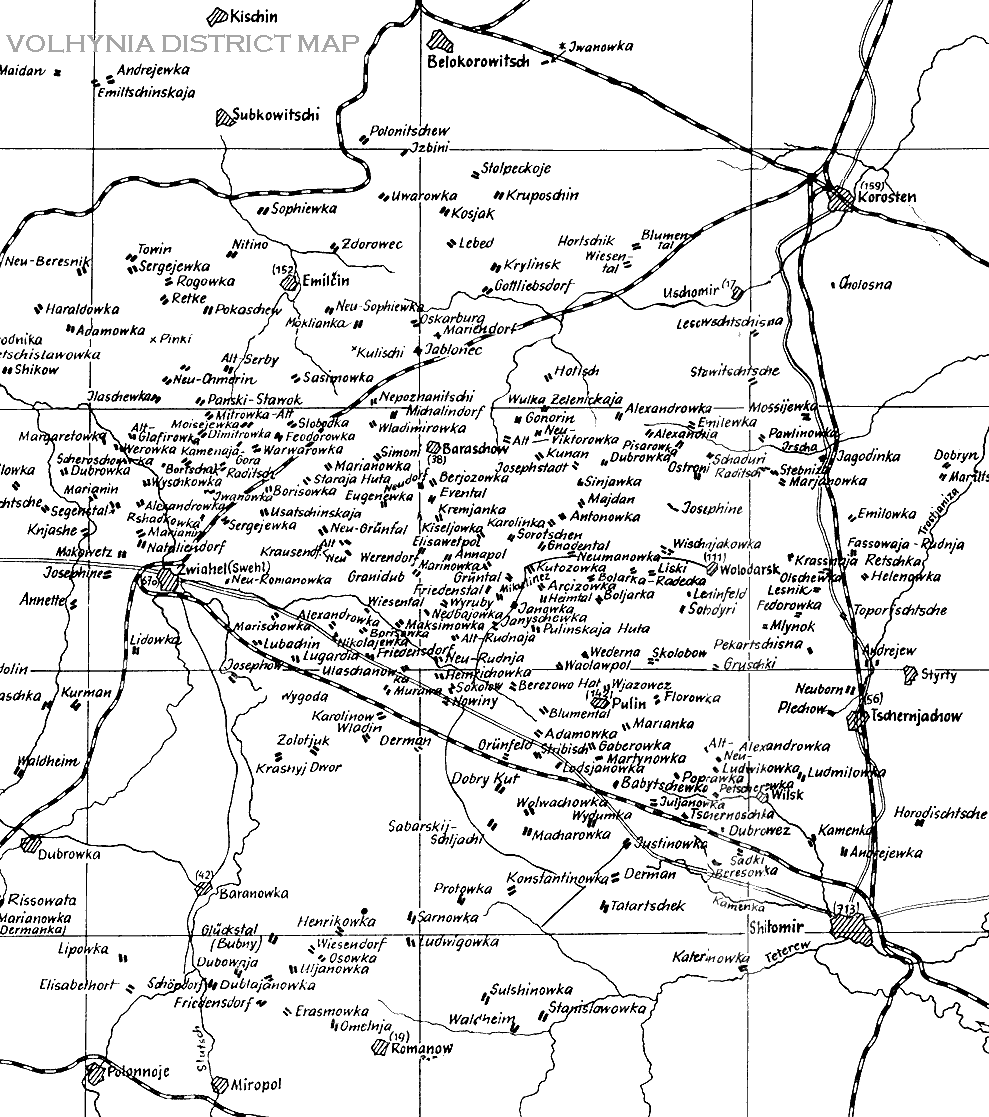
The Volga Germans made a success of the Catherine the Great's German settlement program, trekking eastward to the Volga and colonizing new land. Therefore, an identical program was used by Czar Alexander to encourage German immigration into the Ukrainian areas of Volhynia, acquired from Poland in 1772, and to areas along the Black Sea, acquired from the Ottoman Empire in 1804.
In the summer of 1803 two Germans: Ziegler and Schurter, acting as agents for the Russian Government, were actively recruiting immigrants in Southwest Germany; while in Russia itself extensive preparations were under way for their reception and settlement. The Czar himself and his Minister of Interior, Count Kotchubey, took a very personal interest in the matter. Instructions were issued to the Governors and other Crown officials in the South regarding the reception that was to be accorded to the German immigrants, financial support that was to be given them the areas in which they were to be settled, and other pertinent details. Duc de Richelieu was given the task of buying up suitable agricultural land in the given areas of Odessa region. The Governor of Taurida was instructed to find land in the Crimea for the experienced wine-growers among the immigrants. Kontenius was to supervise the subdivision of the land, the establishment of the newcomers in their village sites, the distribution of support money, and the acquisition of livestock and farm implements. Facilities for the foreign settlers was still far from ready before the end of 1803 when eight transports of more than 200 families, well over 1,000 people led by Ziegler had arrived in Odessa. In 1809, German settlers began arriving in the Beresan Valley, about 80 miles northeast of Odessa.
The Germans they were looking for a better life. Probably the most significant factor to the German migration came about when Napoleon Bonaparte ascended on the scene. During the early 1800's the Rhineland and southwest German states, were subjects of Napoleon. These districts were required to furnish men for his armies, give extensive financial support, and required to quarter the French troops. In addition they were heavy taxes to be paid, together with inclement weather, made conditions so unbearable for the peasants that many were eager to leave for Russia.
The journey to Russia in those days was an ordeal to try the strongest. The routes varied according to the area of origin. The hardship of journey and the first months in the new land were beyond the endurance of many. The journey by boat and wagon and often on foot, took from two to five months, and often meant wintering on the way. Upon arriving at the border the immigrants had to face a quarantine period and then lived in primitive barracks for weeks or months before the settlement site was ready. The mortality rate reached shocking proportions. Many families were almost wiped out and few reached the settlement sites intact. But many still came. When they arrived in Russia and saw the horrible conditions there, some of the families returned to Germany.
The German immigrants came to Black Sea region by the thousands, mainly from the southwestern German states of Wurttenberg, Baden, the Palatinate, the Hessian, and Alsace (now France), where the Napoleonic Wars had the greatest impact. They also came from Hungary and Poland, where some Germans had settled earlier.
In spite of many hardships of the early years; crop failure high mortality rate among children, sickness among animals, the Germans were relatively happy in their adopted land. During the first sixty years the settlers were well treated by the Russian government. Families were extremely large and thus living space in the colonies became scarce. The Germans were thrifty and were able to buy up land all over the countryside from Russian Nobles. Soon the Russians became jealous and pressure was brought to bear on the government to withdraw the special privileges, which had been granted to the settlers. Eventually the government complied with the wishes of Russian people and in the spring of 1871 the colonists were informed by the Ukase of the imperial government that their privileges were gone except for religious freedom. The colonists were astonished as to what had happened. Now they were required to give up their culture, language, and deliver their sons to the Russian army and to become Russians. Deep down in their hearts they knew that eventually they would also have to surrender their religious freedom.
Since the oppression in Russia, they then began to look elsewhere for a more stable life. They began to hear of a better life to be had in the United States. Thus began the great migration to the United States.
Lutheran Parishes in Volhynia link
Zhitomir - 1801
Roshischtsche - 1863 (out of Zhitomir)
Heimtal; 1869 (out of Zhitomir)
Tutschin (Tuczyn) - 1888 (out of Zhitomir)
Nowograd Wolynsk - 1889 (out of Zhitomir)
Wladimir Wolynsk - 1891 (out of Roshischtsche)
Emiltschin  - 1896 (out of Heimtal)
Luzk - 1899 (out of Roshischtsche)
Radomysl - 1901 (out of Kiev)
Rowno - 1902 (out of Tutschin)
Tortschin - 1930 (out of Roschischtsch,
Luck, and Wladimir Wolynsk)
Dubno - 1936 (out of Rowno)
Kostopol - 1936 (out of Tutschin)
Kowel - 1937 (out of Roshischtsche and Wladimir Wolynsk)
Jozefin - 1938 (out of Roshischtsche)
Raditsch is congregation of the Heimtal parish
This web site gives details on the immigration/emmigration of Russian Germans.
Lutheran Parishes in Volhynia link Zhitomir - 1801 Roshischtsche - 1863 (out of Zhitomir) Heimtal; 1869 (out of Zhitomir) Tutschin (Tuczyn) - 1888 (out of Zhitomir) Nowograd Wolynsk - 1889 (out of Zhitomir) Wladimir Wolynsk - 1891 (out of Roshischtsche) Emiltschin - 1896 (out of Heimtal) Luzk - 1899 (out of Roshischtsche) Radomysl - 1901 (out of Kiev) Rowno - 1902 (out of Tutschin) Tortschin - 1930 (out of Roschischtsch, Luck, and Wladimir Wolynsk) Dubno - 1936 (out of Rowno) Kostopol - 1936 (out of Tutschin) Kowel - 1937 (out of Roshischtsche and Wladimir Wolynsk) Jozefin - 1938 (out of Roshischtsche)Walter Koberstein FS.
![[Image]](pict34.jpg)
![[Image]](pict35.jpg)