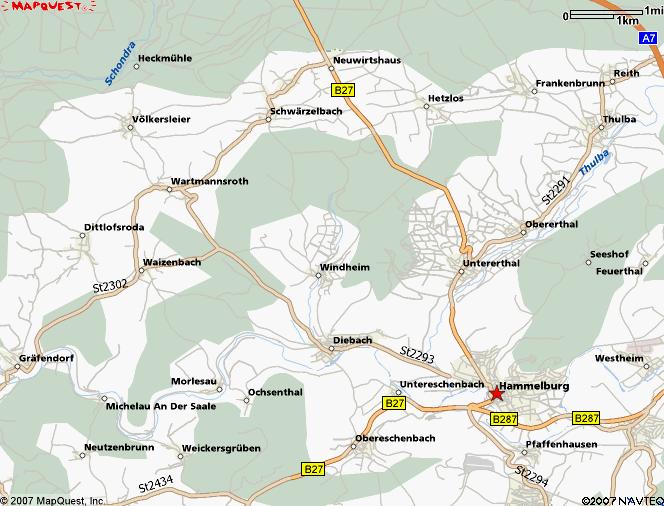
Hammelburg, Unterfranken, Germany
See also the previous general IGI listing for South Germany
On October 23, 2007 there was 1 Koberstein related person from Hammelburg. Here are the illucidated families:
JOH. KOBERSTEIN (Male)
Marriages:
  Spouse:  MARIA HARTLAUB  Family
  Marriage:  21 JAN 1591   Hammelburg, Unterfranken, Bayern
Messages:
 Form submitted by a member of the LDS Church. The form lists the submitter's name and address and may include source information. The address may be outdated. Details vary. To find the form, you must know the batch and sheet number.
Source Information:
 Batch Number:  7613413
 Sheet:  63
 Source Call No.:  1058430   Type:  Film
Hammelburg is a town in the district of Bad Kissingen, in Lower Franconia, Bavaria, Germany. It is situated on the river Fränkische Saale, 25 km west of Schweinfurt.
During WWII, it was the site of the POW Camps OFLAG XIII-B and Stalag XIII-C, as well as the attempted rescue of these camps during Task Force Baum. The American television sitcom Hogan's Heroes (which ran on CBS from 1965 to 1971), featured a fictional Stalag 13, said to be near Hammelburg. The German Army's Infantry School (Infanterieschule) is located in this town.

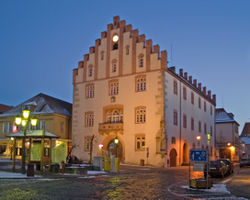

City coat of arms Hammelburg Rathaus Hammelburg Kelleris Schloss
The name Hammelburg is documented for the first time on 18 April 716 as “Hamulo Castellum”. At this time, the Castell in herzoglichem possession was itself extremely traffic-favorably because of the intersection of east-west and north-south export/import and traffic routes. As a Frankish possession in the year 777, Charlemagne donated Hammelburg with its entire "Gemarkung" to the charity of the Holly Bonifatius. The Martinschurch had been already left in 741 by Karlmann to the Bistum Würzburg and possession-legally to the monastery Fulda. Hammelburg, because of its placement at a ford of the Frankish Saale, was of strategic importance. Directly above the river bank, the Frankish king yard was developed over the hall bank. In the 12th century, Fulda built on the opposite linkssaaligen height for the protection of Hammelburg the castle Saaleck, which particularly served for control of the Trimburg established by the Hennebergern. In 1234, Wuerzburg succeeded to appropriate the Trimburg from the Hennebergern. Fulda answered this by moving closer to the old opponent with the attachment Hammelburgs and to the stronger development of castle Saaleck. In the year 1303, under King Albrecht, municipal rights were lent to Hammelburg, the place presented itself as the pile up-richest southernmost fortress Fuldas. The old attachment plant, those with walls and ditches that surrounded the city, had three gate towers (Weiher, Upper and Niedertower) and eleven military towers. From this time still exists the Guardian, Monk and Baderturm, a part of the southern Stadtmauer and the Schlossweiher received. The Hammelburger citizen had begun by selfinitiative in 1302 with the building of a church. This Marienchurch at the cattle market became a symbol of civil self-sufficiency. The building of the parish church pc. Johannes in the old castle district the Hammelburger left to the national gentlemen. The Marienkirche fell victim to a fire in 1854, a fire which also destroyed several other parts of the city. The delighted gothic parish church (1389-1461) is today an object of historical interest. Despite the support of Fulda and Würzburg, Hammelburg changed very early to the Lutheran teachings and only by menace did the city return to the Catholic faith in 1604. 120 Protestant Hammelburger families left their hometown in this year because of it.
KellereischlossA few years later, a furious epidemic cost the city even more of its citizens. Because of the heavy losses of these years the city did not recover until the 18th century. From this blooming time of the 16th century, came the (1524-1526) city hall, a new building made in the Renaissance style, from the architect Johannes Schöner, (1529) where the first council meeting was held therein. Only the lateral stair tower and the city hall cellar remains today. The current city hall, built after the fire in the gothic style, was occupied on December 12, 1859. The Renaissance market well, which was completed in 1541, is likewise a work of the master builder Schöner. Up to the year 1803, Hammelburg belonged to Fulda. It came in the course of the secularization until 1806 at Oranien Naussau. Under Napoleon's brother-in-law, General Murat, the city was (1806-1810) under French administration. In 1810, it assigned the mutton castle to the new Grand Duchy of Frankfurt. After a short Austrian affiliation, the city was integrated 1816 into the new State of Bavaria. In the years after the Second World War the total population of the city was increased by refugees from both Eastern Europe and Eastern Germany and starting from 1956 by the German Federal Armed Forces reorganization. Also in those years, the edge municipalities also saw a large increase in their population. The local reorganisation let the number of inhabitants rise in Hammelburg again. The former municipalities Westheim, Pfaffenhausen, Untererthal, Obererthal, Feuerthal, Morlesau, Obereschenbach with Untereschenbach and Gauaschach attached themselves to the city of Hammelburg, which counts thus approximate 12,500 inhabitants.
The oldest Frankish wine city can be reached extremely favorably by the motorway and has a rich variety of attractions. There are several numerous and partially very well received architectural monuments, cosy restaurants and hotels. The sports center contains outdoor and indoor swimming pools, indoor tennis courts, large-sport-resounds, a soccer stadium, the special landing area for aircraft, recreation sites and good hiking possibilities in variety landscapes of Südrhön and Saaletal-valley inviting tourists to stay. Its proximity to the Autobahn A7 make Hammelburg not only interesting but also as a strategic economic place.
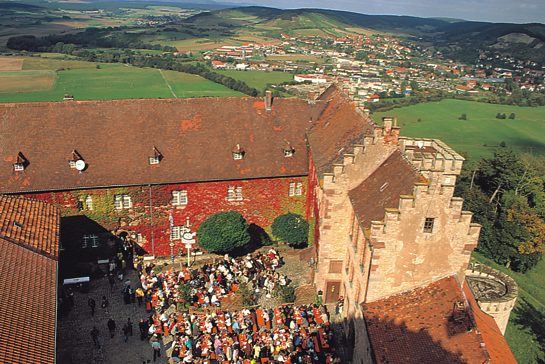
The long history of the town has left many traces for the visitor of today. One example is an old castle named "Schloss Saaleck", which stands high above the baroque monastery and the town. It has become a municipal wine-producing estate and a hotel. There you can enjoy a glass of dry, vintage wine accompanied by a "Häckerbrotzeit", which is a typical Franconia meal made of traditional sausages, meat, cheese and bread. While spending your time there, you have a view over the valley and the river Saale that flows by the side of Hammelburg.