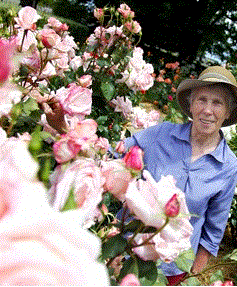
RUTH IN THE ROSES: Manawatu Helmpark garden owner Ruth Koberstein in a cloud of pink petals. At this time of year, visitors walk through fragrance that starts at the ground and goes head high in the rose garden.
| Name: Ruth Koberstein | Recreation/Sport: Flowers |
| Relationship: | Country: New Zealand |
A lifetime spent in the garden Manawatu Standard Senior reporter LEE MATHEWS explores one of Manawatu's most famous iris gardens, which has plenty to offer all year round. If you want to find Ruth and Gordon Koberstein, go and look in the garden. They've spent the last 45 years turning Helmpark from a farm paddock with a swampy watercourse running through it, into a 1-hectare paradise of colour and form. Helmpark was originally Mrs Koberstein's family home. Her parents were dairy farmers 90 years ago on Setters Line, and they planted oak and other English trees that today are tall punctuation points in the garden's structure. Mr and Mrs Koberstein began working the garden about 45 years ago. They've added other deciduous trees, rhododendrons and native shelter hedges, to give the garden shape. "We get all the autumn colours, especially with the maples, and then we get the leaf dump," Mrs Koberstein says. "We compost all the leaves, and in winter you get all those bare, airy branches reaching up and out. The structure's good." The garden is divided into several areas by the trees, and by a stream that meanders through its middle. Mr Koberstein shaped the stream's curves, following its natural line. Then he dug out its bed, lined the edges with iron, and laid thousands of old red bricks to channel the water through the garden. It took months. Driving in, sweeping beds of bearded irises lie in full sun. The Kobersteins breed irises, hybridising for new forms, and they grow favourites for the show bench and for sale. All up, Helmpark has about 500 irises, whose different varieties bloom all year round. In early summer, the rose garden is exploding with colour. A much-needed rain has fallen the day before, and the humid air is heady with rose perfumes. The rose beds are laid out in a long rectangle, with a rectangular centre bed. A path takes visitors between the beds, with big, healthy roses arching up on either side. It's a colour and smell sensation; bright yellow Freesia, blood-red Loving Memory, Aotearoa's unforgettable pale-pink fragrance, and the glowing sunset colours of Remember Me, and variegateds such as Raspberry Ice and Tequila Sunrise. "I don't know all the names," Mrs Koberstein confesses. "We're slowly identifying them, as people who know tell us what they are." Under the trees, shade-loving hostas cluster close, their leaves every shade of green and blue-green possible. Some have variegated silver splashes. They give the trees a foot frill of vegetation. Fuchsias are also enjoying semi-shade, with their dancing-lady flowers. Big perennial beds are full of treasures. Papyrus plants lift yellow flowers high, with bumble bees busy in the nectar. There is a big collection of sweet-smelling pinks, with sweet william making strong colour and smell statements. Honeywort is striking, with blue-black-mauve flowers. A smell from my grandmother's garden tweaks my nose. It's tall, old-fashioned mignonette. Not particularly showy, with a spike of greeny-yellowy flowers just blushed with pink, but the smell is unforgettable. Mrs Koberstein estimates they'd spend five or six hours a day in the garden, working at whatever needs to be done. "My mother used to say there was never a wrong time to garden. You do things as they arise," she said. "When we lived in town, we'd come out and do a full day, and then go home and collapse into the laziboys. It's more leisurely now we live here – we just come out and do whatever needs to be done." The soil is river silt, dumped by the Mangaone Stream. The alluvial is nicely fertile, with enough stone through it to aid drainage. The only area of the garden that does stay wet in prolonged rain is the sunken lawn in front of the house. Their summer mulch of choice is straw, to keep the plants cool and moist. It adds good structure to the fine soil as it breaks down. The water supply is artesian, and a big lemonwood hedge round the north side of the property helps temper the wind. Mrs Koberstein uses succulents as bed edgings, in sunny parts of the garden. They quickly multiply, and their hardiness means they forgive quick shifts. The spring bulbs have finished, but the dahlias and lupins haven't quite got going. The delphiniums are bright and bold, however, in blues and purples and whites. Mr Koberstein says he keeps an eye out for plants new to him, and brings them home to try. Spend 45 years doing this, and the diversity becomes something to behold. "I like a full garden. We split things and move things and just eye them in," he said. Near the vegetable gardens is a cactus, 3 metres high. It started life as a little cutie in a small pot, about 40 years ago. "It has rather lovely creamy-yellow flowers in the season. And it's one thing the possums won't climb." |
|