
| Name: Paul Koberstein | Profession: Environmental Journalist |
| Relationship: Johan WI line | Country: United States of America |
| Paul began his journalism career as a reporter, and then news editor, for a daily newspaper in Wisconsin. Later he was sports writer for the Oregon Journal and then a news reporter for The Oregonian where he worked until 1992. He won numerous state, regional and national journalism awards, including the top prize for investigative reporting from the Oregon Newspaper Publishers Association in 1986, 1988 and 1991. He was nominated for a Pulitzer Prize in 1990, along with co-author Kathie Durbin, for a series documenting the devastating impact of logging on Northwest forests. That landmark series kicked off the notorious spotted owl debate. Paul has covered numerous major Northwest environmental stories for more than a decade. He was the first reporter on the scene of the oil spill by Exxon Valdez, Alaska, and he's credited with breaking the news that nuclear waste tanks could explode at Hanford - a story that eerily prompted government contractors to hire surveillance specialists to follow him for months. In 1993-94, Paul was a staff writer for Willamette Week. He has written for such national publications as Time and Outside, and in 1995 contributed to a series of articles that won the National Magazine Award for Outside. He has also scripted several documentary films. In 1994 he founded Cascadia Times out of frustration with the unwillingness of major newspapers to invest in in-depth coverage. Paul thrives on striving against the grain, digging deeply into a subject to get to the dirt of a story. He has earned his reputation as a formidable agitator to polluters, officials and sometimes his editors as well. | |
| On Earth, Spring 2005 reported
Oakes Award Journalist Exposes Something Fishy The eleventh annual John B. Oakes Award for Distinguished Environmental Journalism was presented to Paul Koberstein of the Cascadia Times of Portland, Oregon, whose report "Plundering the Pacific" revealed rampant conflicts of interest in federal fisheries management. Koberstein exposed two members of a council that oversees Pacific fishing who not only were fishermen, but who also sold equipment to fellow fishermen and often broke their own rules. During the 1990s, longline fishermen killed about 1,500 endangered leatherback sea turtles each year. |
Paul Koberstein |
U.S. Phone and Address Directories, 1993-2002 Name: Paul Koberstein Address: 8585 SW Canyon Ln City: Portland State: Oregon Zip Code: 97225-3964 Phone Number: 503-292-5120 Residence Years: 1998 1999 2000 2001 2002 |
|
Linkedin.com
Paul Koberstein Location: Portland, Oregon Area Industry: Newspapers Current Editor at Cascadia Times Education University of Oregon |
|
| The NW Examiner Versus ESCO, Round 3
12:19 PM November 9th, 2009 by Nigel Jaquiss The Examiner hired freelancer Paul Koberstein, a veteran environmental reporter who has written for The Oregonian, WW and other publications, to examine ESCO’s emissions, which have been a major point of contention in the neighborhood. This month’s issue also includes a back-and-forth between Koberstein and ESCO’s environmental manager, Carter Webb, over last month’s piece. http://blogs.wweek.com/news/2009/11/09/the-nw-examiner-versus-esco-round-2/ |
|
Investigative series turns lens on AmeriTies
A three-part series this week first looked at the AmeriTies West tie plant operations and then at what the plant has done to address odor complaints concerning naphthalene. Today, it recaps an investigative series by the Cascadia Times that says residents in The Dalles are breathing toxic air. A recent three-part series by award winning investigative and environmental reporter Paul Koberstein turned a sharply critical lens on AmeriTies West. Writing in the environmental publication Cascadia Times, Koberstein looked at air quality complaints filed with the Oregon Department of Environmental Quality against AmeriTies, and found many of them came from four women in The Dalles. Naphthalene is one of the thousands of chemicals in creosote, a wood preservative used by AmeriTies to treat railroad ties for its sole customer, Union Pacific Railroad. Two of the women, Kristina Cronkright and Rachel Najjar, moved away because of health issues, in themselves and their children, while two others have stayed. Sherrin Ungren and Tiffany Woodside still live here. Woodside told Koberstein she can’t afford to move, even though her doctor advised it, and she feels like a prisoner in her own home because of the naphthalene released by the plant. As part of his months of research, Koberstein read numerous government reports, including ones by the federal Agency for Toxic Substances and Disease Registry (ATSDR). That agency recently completed a health consultation that concluded levels of naphthalene in The Dalles do not pose a chronic non-cancer public health hazard. It found that long term exposures to naphthalene levels present would lead to two cancer diagnoses in 100,000 lifetimes. The consultation did acknowledge that odors can cause physical symptoms and affect quality of life. One of the four women Koberstein interviewed, Cronkright, called the health consultation a “waste of paper.” The consultation looked only at air quality data, and did not include interviews with people or testing of substances like soil, house dust or water. Koberstein talked to an expert who said ATSDR relied on out of date federal standards. He found that expert, noted toxicologist Dr. James Dahlgren, through some of ATSDR’s own studies, which quoted Dahlgren’s work on naphthalene. Dahlgren’s papers analyzed the health effects of naphthalene, and Koberstein said the health complaints listed by the local women were identical or nearly identical to the health effects listed by Dahlgren. They include symptoms like skin rashes, anemia, neurological problems like light-headedness and irritability, and extreme fatigue. Dahlgren told Koberstein his research shows that exposure to the “very low” levels of wood treatment chemicals found in the air in The Dalles and elsewhere can cause serious health problems. State air quality studies have shown naphthalene levels in air samples were cut in half after the plant in 2016 halved the amount of naphthalene it uses in treating ties. In the 2017 data, the average concentrations of naphthalene found at all three monitoring stations in The Dalles were above the benchmark for cancer risk, but below the benchmark for non-cancer health effects. The current cancer risk benchmark for naphthalene is .03 micrograms per cubic meter. The non-cancer risk level is 3.7 micrograms per cubic meter. “We examined the science behind the numbers, the actual data that has led agencies to state that there are health effects from air exposures to these chemicals. And we compared that data with anecdotal reports from people in The Dalles and we found a very strong consistency,” Koberstein said. “That was the design of our project: to compare the science with the anecdotal reports from people.” Koberstein learned about a now-closed tie plant in Columbus, Miss., where residents sued the plant owner, Kerr-McGee Chemical Corp., which also owned the tie plant in The Dalles at the time, and the company eventually agreed to pay $62.5 million for health impacts and site cleanup costs. That plant closed in 2003. Dahlgren, a professor at the UCLA school of medicine who also worked on the water pollution case made famous in the movie “Erin Brockovich,” looked at 50 years of production data from the Columbus plant and estimated how much naphthalene was in the air during its decades of operation. Koberstein decided to compare Dahlgren’s computer models to emissions from The Dalles, and found levels in The Dalles were 182 times higher than the peak level found in Columbus. Kerr-McGee spun off its plant in The Dalles in early 2005, and later that year spun off its other tie plants to a company called Tronox, Koberstein found in his search of court documents. When Tronox was established, it was funded with $40 million to settle health and cleanup claims, but the U.S. Environmental Protection Agency determined there was at least $25 billion in such costs. Tronox filed for bankruptcy in 2009, and the bankruptcy judge stated several times in 2013 court documents that he believed fraud was committed, Koberstein said. On the Facebook page the four women created, called The Dalles Air Coalition, the women have complained that when they post anything critical about air quality related to AmeriTies on other community Facebook pages, the posts are taken down. |
|

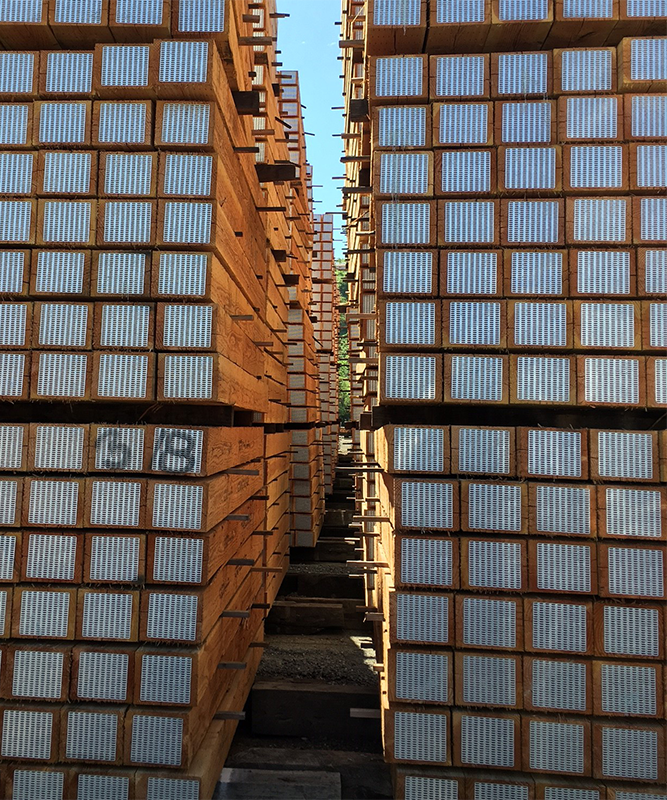 Untreated ties are stacked at the AmeriTies plant in The Dalles. Once treated, they will be stored tightly packed to dry in an effort to reduce the odors released by the creosote and slurry oil used to treat them. Treatment is used to increase the usable life of the ties.
Neita Cecil
Untreated ties are stacked at the AmeriTies plant in The Dalles. Once treated, they will be stored tightly packed to dry in an effort to reduce the odors released by the creosote and slurry oil used to treat them. Treatment is used to increase the usable life of the ties.
Neita Cecil