![[Image]](pict1.jpg)
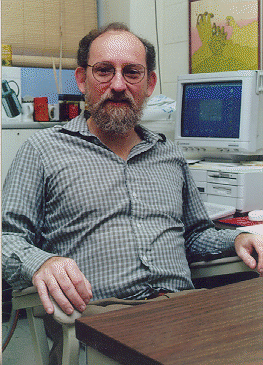
| Name: Dr. Jeffrey T. Koberstein | Profession: Polymer Professor |
| Relationship: Johann WI line | Country: United States of America |
| University
of Conn. Dept. Head of Polymer science
Columbia University Department of Chemical Engineering Faculty : Members : Jeffrey T. Koberstein Name: Jeffrey T. Koberstein Title: Associate Professor Contact info: Mailing address: 809 Mudd 500 W. 120th Street Columbia University, MC 4721 New York, NY, 10027 Phone number: (212) 854-3120 Email address: jk1191@columbia.edu education: BS Chemical Engineering, Univ. of Wisconsin 1974 PhD Chemical Engineering, Univ. of Mass 1979 Research interests: Prof. Koberstein's research interests lie in developing fundamental relationships between molecular structure and properties of polymers and other soft matter, and particularly how polymer surfaces and interfaces can be designed from a molecular perspective. Creating Smart Polymer Surfaces: Smart polymer surfaces are defined by the ability to change structure and properties when exposed to a particular stimulus. The goal of this work can be generally considered as gaining a molecular design capability to change the chemical composition of a polymer surface through external controls. To accomplish these goals, fundamental research on functional polymer surfaces is carried out on model systems such as end-functional polymers. Surface properties are determined as a function of molecular variables using sophisticated techniques such as x-ray photoelectron spectroscopy, interfacial tensiometry/contact angle analysis, x-ray and neutron reflectivity and ellipsometry. Current projects involve investigations of reorganization of functional groups at surfaces, the use of light to create surface functionality, the use of functional surface active block copolymers to create smart surfaces, adhesion enhancement with functional polymers, surface segregation in multicomponent polymer systems, supercritical fluid based surface modification technology and photoisomerization to control functionality and reactivity at polymer surfaces. Bioactive Polymer Surfaces: The goal of this research is to develop polymer surfaces that can promote a certain prescribed biological response when placed in vivo. An example of the need for this capability is an implantable glucose sensor. Normally these sensors fail within weeks as they become encapsulated with fibrous tissue due to the body's immune response. Bioactive coatings are under development to reduce encapsulation and induce the growth of new capillary vessels. These coatings are based on new types of polymeric hydrogels and block copolymers that can be decorated with cell signaling factors such as cell adhesion ligands and growth factors. Projects involve the synthesis of new hydrogels, characterization of their properties and cellular response, and the development of strategies for surface patterning of biological molecules for the development of microarray biosensors. Selected Publications: Interfacial Tension Reduction in Polystyrene/Poly(dimethylsiloxane) Blends by the Addition of Poly(styrene-b-dimethyl Siloxane), with W. Hu, J.P. Lingelser and Y. Gallot, Macromolecules, 28, 5209-5214, (1995). End Group Effects on Surface Properties of Polymers: Semi-Empirical Calculations and Comparison to Experimental Surface Tensions for ???-Functional Poly(dimethyl siloxanes", Claire Jalbert, Jeffrey T. Koberstein, Arvind Hariharan and Sanat K. Kumar, Macromolecules 30(15),4481-4490 (1997). Creating Smart Polymer Surfaces with Selective Adhesion Propertie", J. T. Koberstein, D. E. Duch, W. Hu, T. J. Lenk, R. Bhatia, H. R. Brown, J.-P. Lingelser, and Y. Gallot, J. Adhesion, 66, 229-249 (1998). The Effects of Low Energy End Groups on the Dewetting Dynamics of Poly(styrene) Films on Poly(methyl methacrylate) Substrates, C. Yuan, M. Ouyang and J. T. Koberstein, Macromolecules, 32 (7), 2329-2333 (1999). Segregation Dynamics of Block Copolymers to an Immiscible Polymer Blend Interface, D. Cho, C. Jalbert and J. T. Koberstein, Macromolecules 33(14), 5425-5251 (2000). Conversion of Some Siloxane Polymers to Silicon Oxides by UV-Ozone Photochemical Processes, M. Ouyang, C. Yuan, R. Muisenerm A. Boulares, J. T. Koberstein, Chemistry of Materials, 12(6), 1591-1596 (2000)
136 Jeffrey Thomas Koberstein 2312751 Koberstein, Jeffrey T. 1952- Who's Who in Technology. Sixth edition. Two volumes. Detroit: Gale Research, 1989.(WhoTech 6) Who's Who in Technology. Seventh edition. Detroit: Gale Research, 1995.(WhoTech 7) Who's Who in Technology Today. Fourth edition. Five volumes. Edited by Barbara A. Tinucci. Lake Bluff, IL: Research Publications, J. Dick Publishing, 1984. Use the 'Index of Names,' which begins on page 1125 of Volume 5, to locate biographies.(WhoTech 4) 2312752 Koberstein, Jeffrey Thomas 1952- American Men & Women of Science. A biographical directory of today's leaders in physical, biological, and related sciences. 15th edition. Seven volumes. New York: R.R. Bowker Co., 1982.(AmMWSc 15) American Men & Women of Science. A biographical directory of today's leaders in physical, biological, and related sciences. 16th edition. Eight volumes. New York: R.R. Bowker Co., 1986.(AmMWSc 16) American Men & Women of Science. A biographical directory of today's leaders in physical, biological, and related sciences. 17th edition. Eight volumes. New York: R.R. Bowker Co., 1989.(AmMWSc 17) American Men & Women of Science. A biographical directory of today's leaders in physical, biological and related sciences. 18th edition, 1992-1993. Eight volumes. New Providence, NJ: R.R. Bowker Co., 1992.(AmMWSc 18) American Men & Women of Science(TM) (Bowker(R)). A biographical directory of today's leaders in physical, biological and related sciences. 19th edition. Eight volumes. New Providence, NJ: R.R. Bowker Co., 1994.(AmMWSc 19) American Men & Women of Science(TM) (Bowker(R)). A biographical directory of today's leaders in physical, biological and related sciences. 20th edition. Eight volumes. New Providence, NJ: R.R. Bowker Co., 1998.(AmMWSc 20) American Men & Women of Science. A biographical directory of today's leaders in physical, biological and related sciences. 21st edition. Eight volumes. Detroit: Gale Group, 2003.(AmMWSc 21) Who's Who in Frontier Science and Technology. First edition, 1984-1985. Chicago: Marquis Who's Who, 1984.(WhoFrS) Who's Who in Science and Engineering(R) (Marquis(TM)). Fifth edition, 2000-2001. New Providence, NJ: Marquis Who's Who, 1999.(WhoScEn 5)
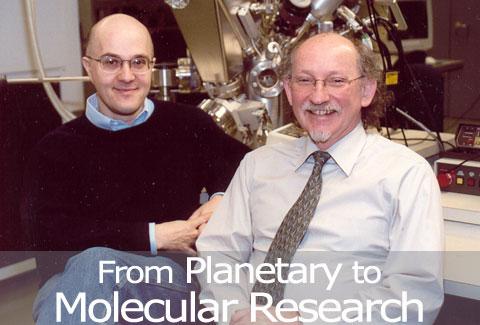
The National Science Foundation has given Columbia Engineering grants totaling $5.6 million for two interdisciplinary areas whose foci range from the global to the molecular. Lorenzo Polvani (left in picture), who holds joint appointments as professor of Applied Physics & Applied Mathematics and Earth & Environmental Sciences, is principal investigator for a $2.9 million grant to investigate global problems that occur at the interface between applied mathematics and the earth sciences. Jeffrey Koberstein (right in picture), chair of the Department of Chemical Engineering, will oversee a grant of $2.7 million with Morton M. Denn of CCNY that will focus on the interface of chemical engineering, chemistry and physics as it applies to all forms of soft material, from polymers to body tissue. The other IGERT grant, for $2.7 million, has a focus that is infinitesimal compared to the global nature of the earth sciences IGERT. The interdisciplinary chemistry, physics and chemical engineering focus will be on multiscale phenomena in soft materials. Chemical engineering’s Koberstein describes the subject matter of the grant as encompassing everything from surfactants, plastics, pharmaceuticals, and ceramics, to minerals, food, textiles, proteins, biological tissue and guitar strings. “Our students will investigate properties on length-scale structure and our goal is to look at different length-scales and see what effect that has on matter,” said Koberstein. “Think of it as a three-dimensional fishnet and the distance between the knots in the net can be long or short. For example, with the same material, a simple polymer like polybutadiene, if the length-scale is large, it behaves like a rubber band; if the length-scale is short, the material becomes ebonite, which is used for bowling balls.” The Chemical Engineering grant is not only interdisciplinary but also inter-institutional. In a unique partnering, Columbia is working with principals at City College of New York’s Levich Institute for Physico-Chemical Hydrodynamics and CCNY’s Departments of Chemical Engineering, Physics, and Mechanical Engineering. “The goal is to allow SEAS and CCNY students the opportunity to take advantage of a strong interdisciplinary program while studying in a synergistic atmosphere created by the inter-institutional environment that our two universities have in the field of soft materials,” said Koberstein. “This is the first time that Columbia has exploited the strengths of a neighboring public university to pioneer a new paradigm for graduate education and research in the urban environment.” Among the areas of investigation will be studies of the thermal and dynamic properties of ultra-thin films to better understand their behavior; how polymers flow through confined spaces; the effects of liquid crystalline polymers on thermoplastics; and developing smart coatings for “labs on a chip.” “There is a new spirit evolving at Columbia,” said Koberstein, “with new shared facilities and interdisciplinary research. We are not insular; we are using MRSEC facilities (see story on page 3) and we are able to offer our students many choices. Having choices is a good thing for education. Everybody learns much better when the menu is longer.” The IGERT program provides full tuition scholarships and stipends plus funds to support the students’ own work, and can be used for travel to conferences, for computers and laboratory equipment or research equipment. The program guarantees placement for one summer for all Fellows in an internship at a research institution, national laboratory or industrial research center. Additionally, Fellows receive specific training in skills that will help them become better scientists, such as selecting good research problems, giving effective presentations, preparing successful research proposals and developing an awareness of ethical issues in the surrounding research |
|