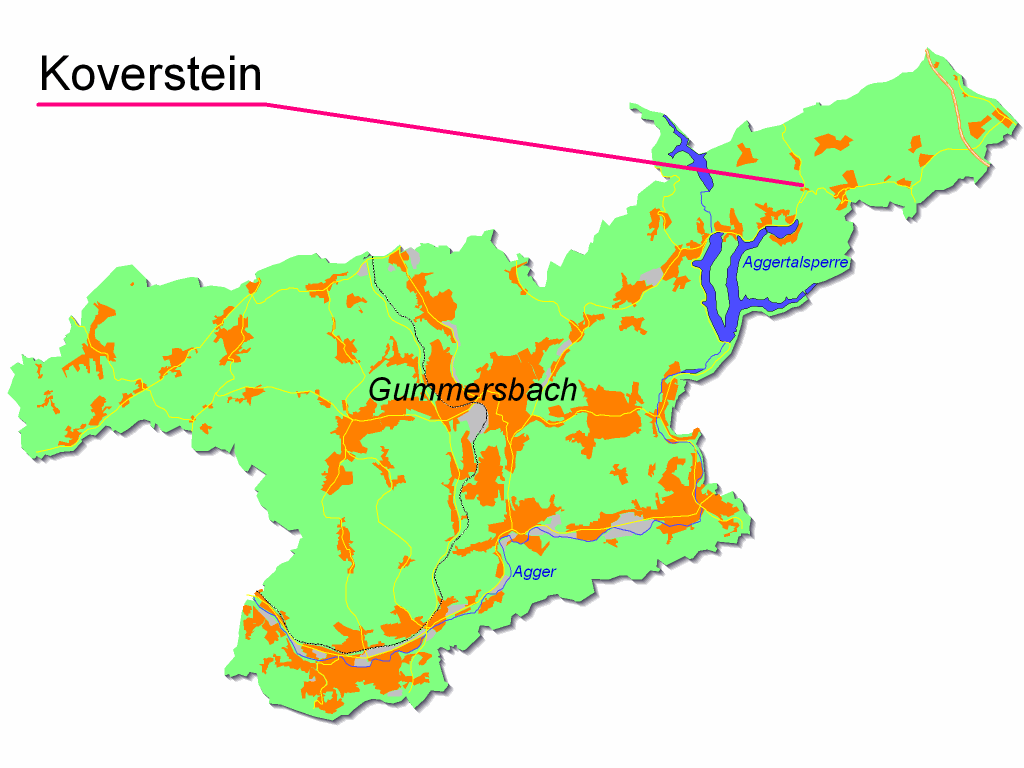
Here is the Wikilink for Koverstein and the GenWiki Link.
Here is a general map of the location of Koverstein Castle.
This quote starts from about midway on page 10.
Also look at Page 11 in the Koberstein Genealogie book.
2. Koverstein Castle
Edward Schröder, "German naming science", Göttingen 1938, writes: "Koverstein in Bergischen after Koberstein in the Westerwald and this named after Kobern on the Moselle".
City historian Mr. Pomykaj, Gummersbach, announced the following on March 23, 1993:
Koverstein was a noble seat in the Märkisches Amt Neustadt, the later imperial rule Gimborn - Neustadt. It is not very far from Lieberhausen and is now in the urban area of Gummersbach. According to Dittmaier, the name appears in documents as early as 1342. Johann von Coverstein was officially granted a right castle loan in the parish of Lieberhausen on April 3, 1413 by the Counts Adolph von Cleve and von der Mark.
The small moated castle had to be laid down in 1865 due to dilapidation and has now been included in the Gummerbach monument list as a ground monument. The list contains the following brief description:
"Koverstein in the meadows west of the Agger is a debris hill surrounded by a shallow ditch with a dam. The diameter of the hill is approx. 12 m, height still 1.5 m, and the ditch width is 10 - 20 m The Koverstein moated castle. The rectangular castle building, facing northwest - facing southeast, was about 20 m long and 10 m wide (floor plan in the cadastre). "
The Koversteiner mill was dismantled and rebuilt in the Kommern open-air museum in the Eifel. So it is still preserved in another place.
Page 3
3. Koberstein Castle in Moravia
When in the 12th century the flow of recolonizers began to flow east again, the condition for creating cultural certificates was more favorable than before. Silesia is also open to the south via the Marsh Valley leading to the Danube. Southern influences penetrate the country. The outskirts, the Sudetes, have not proven to be an obstacle to settlement. The settler flows flowed unhindered along both sides of the mountain, keeping in contact with each other, so that there were similar conditions on both sides. From the blood of the population of Germanic and Slavic descent and again of West German origin flowing from various sources, a special breed of people resulted, whose diverse blood mixture triggered strong creative powers.